🏏
Cricket Reflex Test
Ready to Bat? Click to start!
⚡
Pro Batsman
150-190ms
🏏
Average
240-280ms
🐢
Tailender
350ms+
Cricket Reaction Time Test: How to Improve Your Batting and Fielding Reflexes?
Cricket is a sport where a mere hundredth of a second (a millisecond) determines the difference between victory and defeat. When a fast bowler delivers a ball at speeds of 145 kmph, a batsman has only 400 to 450 milliseconds to make a decision. For this very reason, the Cricket Reaction Time Test has become essential for every cricketer in the modern era.
In this article, we will explore how you can measure your reflexes and discover which drills can help transform you into a professional player.
What is Reaction Time, and Why is it Important in Cricket?
Reaction time refers to the duration it takes for your brain to process a visual signal—specifically, the release of the ball—and issue a command to your body to take action. In the context of cricket, this process is known as Visual Processing.
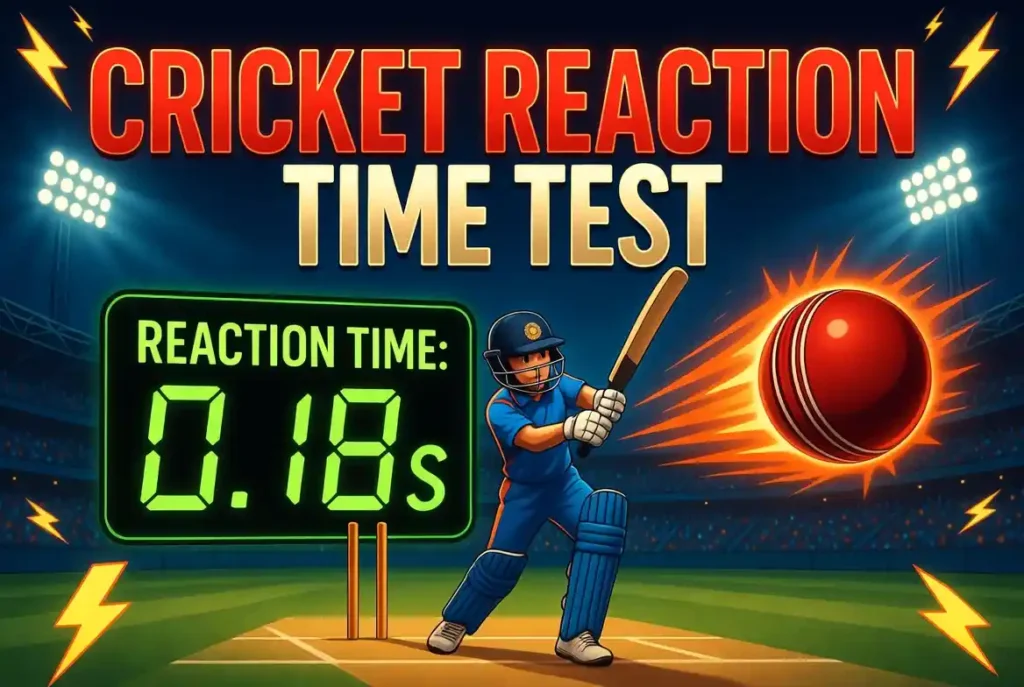
A superior reaction speed translates to:
Quickly judging the line and length of the ball.
Making rapid catches while fielding in the slips.
Instantly reacting to edges while wicket-keeping.
Cricket Reaction Time Test: How to Check Your Speed?
To determine your current reaction speed, you can utilize the methods outlined below:
- Online Cricket Reaction Time Tests
Nowadays, various micro-tools are available on the internet that measure the speed at which you click on your screen. These tests provide an indication of how quickly your brain is reacting. - The Ruler Drop Test
This is a physical test that you can easily perform at home. A friend holds a ruler (scale) and drops it without giving you any prior warning. Your objective is to catch it mid-fall. Based on the specific point at which you catch the ruler, your reaction time can be calculated in milliseconds (ms). 3. Batting Reaction Speed Drills
During net practice, you can test and improve your batting reaction speed by increasing the speed of the bowling machine or by reducing the distance (short-pitch practice).
Top Training Drills to Improve Reflexes
If you are looking to improve your cricket reflexes, incorporate these exercises into your routine:
Reaction Ball Drills
A Reaction/Reflex Ball is a six-sided ball that can bounce in any direction after hitting the ground. Throwing it against a wall and catching it leads to significant improvements in fielding skills and hand-eye coordination.
Blindfold Reaction Drill
In this drill, the fielder keeps their eyes closed; they only open their eyes to catch the ball when their partner calls out “Go” while throwing it. This drill enhances concentration and focus.
Color Ball Drill
This training method utilizes tennis balls of various colors. As the coach throws the ball, they call out a specific color (e.g., “Red!”), and the batsman must only attempt to hit the ball of that particular color. This accelerates decision-making speed.
Essential Equipment and Gadgets for Training
Modern cricket increasingly relies on technology. Some popular tools include:
BlazePod Cricket: These are light-based pods that light up in a random sequence. The player must touch them to switch them off.
Slip Catching Cradle: This is an excellent tool for fielding practice, designed to simulate unpredictable edges off the bat.
Sidearm Pro/Elite: This throwing aid allows a coach to deliver balls at speeds exceeding 140 km/h without experiencing fatigue.
Cricket Catching Bats: These are specialized, slender bats used to enhance the precision and catching skills of wicketkeepers and slip fielders.
How to Improve Reflexes at Home?
Not everyone has access to a bowling machine or expensive training gadgets. You can also practice using a tennis ball and a wall:
Wall Volleys: Hit a tennis ball against a wall and catch it with one hand.
Table Tennis: Playing table tennis improves hand-eye coordination.
Juggling: Juggling with three balls enhances peripheral vision.
Conclusion: Practice and Consistency
A batsman’s average reaction time improves only when they work on developing muscle memory. The more drills you perform, the faster your brain will begin to handle the ball in “auto-pilot” mode.
Whether you are performing wicket-keeping reflex exercises or slip fielding reaction tests, remember that consistency is the key.
Frequently Asked Questions (FAQs)
What is a good reaction time for a cricketer?
For professional cricketers, an elite reaction time is typically under 200ms to 250ms. However, for most amateur and club-level players, an average reaction time between 250ms and 350ms is considered quite good.
Can I really improve my reflexes for cricket?
Yes! While genetics play a small role, reflexes are largely governed by Muscle Memory and Visual Processing. Regular training with reaction balls, shadow batting, and specific drills can significantly lower your response time over time.
Does playing video games help with cricket reflexes?
To an extent, yes. Action-based video games improve “hand-eye coordination” and the brain’s ability to process visual information quickly. However, they don’t train the specific “footwork” and “body balance” required on the cricket field.
Why is my reaction time slower on my phone/computer?
This is often due to Input Lag. Digital screens, Bluetooth devices, and slow touch-sample rates on smartphones can add 50ms to 100ms to your actual score. For the most accurate results, use a device with a high refresh rate.
How does a “Ruler Drop Test” compare to an online test?
The Ruler Drop Test is a physical measurement of gravity and grip, while an online test measures cognitive processing and finger-tap speed. Both are useful, but the ruler test is often more “realistic” for physical sports like cricket.
Does age affect cricket reaction time?
Generally, reaction times are fastest in the late teens and early 20s. As we age, neural processing slows down slightly. However, experienced players often compensate for this by better Anticipation—reading the bowler’s action before the ball is even released.
How often should I practice reflex drills?
Reflex training is high-intensity for the brain. It is best to practice in short bursts of 10 to 15 minutes daily, rather than one long session. This keeps the nervous system sharp without causing mental fatigue.
What is the best equipment to improve fielding reflexes?
The Reaction Ball (Z-ball) and a Slip Catching Cradle are the most effective and affordable tools for fielders. They simulate the unpredictable nature of a cricket ball’s path.